
If there's one theme defining physical security trends in 2026, it's the industry's decisive shift from documenting incidents after the fact to preventing them before they happen. For years, security cameras have done exactly what their name implies — they watch. But watching and recording isn't the same as protecting. That distinction has never been more important, and it's driving one of the most significant transformations in modern security infrastructure.
Industry analysts at Pinkerton, Genetec, and Arxys all converged on the same prediction heading into this year: AI-driven, proactive security systems will become the new standard. Genetec specifically forecasted a move away from generic AI hype toward "intelligent automation" — systems that streamline workflows, surface meaningful signals from massive data streams, and enable real-time intervention. It's not just about smarter cameras. It's about systems that act.
What Proactive Security Actually Means
The term gets thrown around loosely, but in practice, proactive security combines three capabilities that legacy systems simply can't replicate: real-time behavioral detection, automated response, and contextual awareness. A traditional motion alert tells you something moved. A proactive AI system tells you who is moving, where they shouldn't be, and responds before you have to.
This is exactly where Verkada's February 2026 AI-Powered Deterrence release lands — and in my view, it's one of the most practically impactful product launches in emerging security technologies 2026 has seen so far.
Verkada AI-Powered Deterrence: How It Actually Works
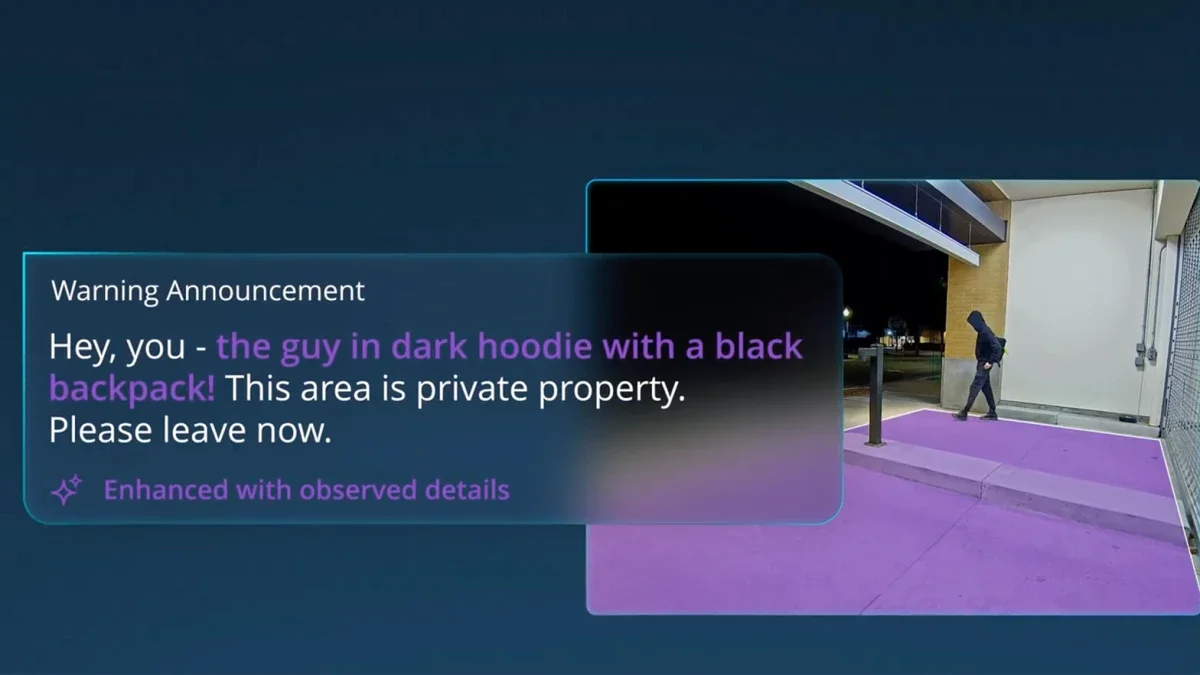
Released to public beta on February 12, 2026, Verkada's AI-Powered Deterrence leverages large vision, audio, and language models running within the cloud-based Command platform. When the system detects unauthorized behavior — loitering near a restricted zone, someone in an off-limits area after hours — it doesn't immediately trigger a full alarm. Instead, it initiates a calibrated escalation.
The first intervention is a context-aware, AI-generated voice warning. Not a generic "you are trespassing" message — something like: "Hey, you with the red hoodie and backpack — you can't be in this area right now." That specificity matters. It signals to a potential bad actor that they've been seen, which on its own is one of the most effective deterrents in physical security. If the person remains, warnings escalate in volume and urgency before triggering sirens, live agent talk-down, or law enforcement dispatch.
Two details worth highlighting for anyone evaluating this in a real deployment: First, the system randomizes voice profiles across incidents, specifically to prevent repeat offenders from tuning out a familiar tone. Second, the feature now extends to Verkada intercoms, enabling discreet placement at entrances and gates without requiring a full camera mounting — a practical advantage for sites with aesthetic or space constraints.
Fighting Detection and Compound Alerts: Filling the Gaps
AI-Powered Deterrence isn't rolling out in isolation. Around February 19-20, Verkada released Fighting Detection to all organizations — an activity detection capability that identifies physical altercations in real time and fires targeted alerts to security teams. Paired with AI-Powered Deterrence, you now have a system that can deter unauthorized access and respond to active incidents within the protected perimeter.
Compound alerts, reaching full availability March 30, add another layer of precision: configurable multi-condition notifications that reduce false positives by requiring multiple criteria to be met simultaneously. A worker crossing a line and missing their hard hat. A vehicle in a restricted lot after hours. That kind of contextual filtering is what makes proactive security solutions operationally viable at scale — without burying security teams in noise.
Why This Matters Specifically in Hawaii
From hands-on deployments across the Hawaiian Islands, a few factors make these capabilities particularly relevant for local organizations. Island geography means response times can be longer — law enforcement resources are distributed across communities that are geographically isolated from each other. A system that deters and documents before an incident escalates has measurable value when every minute of response delay matters.
Multi-site operations — whether a retail group across Oahu and Maui, a school complex on the Big Island, or a state agency managing facilities across multiple islands — benefit enormously from cloud-based physical security in Hawaii. Verkada's architecture eliminates on-premises NVR hardware, delivers automatic firmware updates, and enables remote management from a single interface. That's not just a convenience — it's an operational necessity for organizations that can't have a dedicated IT security resource at every location.
Zero Trust physical security principles are also gaining traction in regulated sectors like state DOE schools and government agencies, where compliance requirements increasingly mirror those in cybersecurity. Verkada's integrated approach — combining video intelligence, access control, alarms, and intercoms on one platform — makes it significantly easier to demonstrate layered access controls and audit trails when those conversations come up.
The Bigger Picture
What Verkada's 2026 releases represent isn't just a feature update — it's an architectural statement. Proactive security solutions aren't emerging from the margins anymore. They're becoming the baseline expectation, and organizations that continue relying on reactive monitoring are accepting a capability gap that will only widen.
At Unified Security Partners, we've provided Verkada solutions for Hawaiian businesses, schools, and state agencies since 2019. If your organization is evaluating where AI in access control and deterrence fits into your current security posture, we're glad to walk through what a practical deployment looks like for your specific environment.
Unified Security Partners is a Verkada Gold authorized partner serving organizations across Oahu, Maui, Kauai, and the Big Island.