
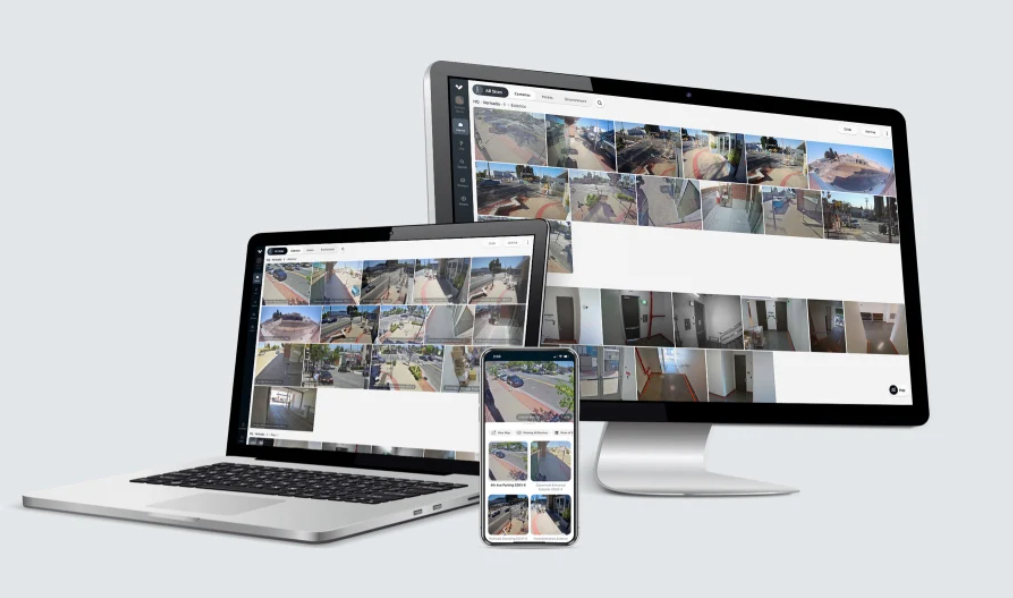
Quick answer: The security hardware sold on Maui is the same hardware sold on Oahu — what changes is everything that happens after it's mounted. On a neighbor island a failed recorder or a video pull can turn into a plane ticket, which is why cloud-managed systems have taken over Maui's commercial market. Budget the same per-camera and per-door ranges you'd see on Oahu, register your alarm with Maui County through CryWolf, and specify hardware rated for salt air anywhere near the shoreline.
If you run a business in Kahului, Wailuku, Kihei or Lahaina, you've probably had a version of this conversation: you call about a camera that's been dark for a month, and the answer is that someone can look at it "next time we're on-island." That gap — not the equipment — is the real difference between buying security on Maui and buying it on Oahu.
What's different about buying a security system on Maui?
Support logistics, not equipment. The cameras, readers and alarm panels available on Maui are identical to what's sold anywhere else in the state; what differs is the cost and delay of touching them once they're mounted. Three consequences follow:
- Every truck roll is expensive. A visit that's an hour of drive time on Oahu can be a half-day of flights and rental cars for a vendor without on-island people. That cost shows up either in your service contract or as slow response.
- Parts don't arrive overnight. Replacement hardware generally moves by barge through Kahului Harbor, with inter-island air freight as the expensive alternative. Systems built around proprietary recorders and hard drives feel this most — a failed drive is a shipment, not a swap.
- Nobody local is going to babysit a server closet. Most Maui businesses don't have IT staff on site, and a recorder that quietly stops writing video is the failure we most often hear about after the fact.
The practical answer is to choose a system where routine work — checking health, updating firmware, adding users, pulling footage — happens over the internet instead of in person.
Do I need a local security company on Maui, or can I use an Oahu vendor?
You can use an Oahu-based vendor — the question is what work requires someone physically on Maui, and who does it. With a cloud platform the list is short: initial installation and hardware replacement. Everything else is remote, including after-hours watching: remote video monitoring in Hawaii covers a Kahului warehouse with the same agents that cover a Honolulu site. Four questions worth asking before you sign:
- If a camera goes offline tonight, what happens tomorrow morning — and does anyone need to fly?
- Who performs the physical installation on Maui, and are they licensed here?
- If hardware fails in warranty, who ships the replacement and who pays the freight?
- Can I pull live video and an export myself from my phone, without calling anyone?
Unified Security Partners is a Honolulu-based Verkada Gold Partner serving all the Hawaiian Islands since 2019. We handle site assessment, system design, configuration, licensing and ongoing support; physical installation is performed by licensed contractor partners. That split is deliberate — the day-to-day work on your system doesn't depend on anyone getting on a plane.
Cloud cameras or an NVR — which makes more sense on Maui?
Cloud-managed cameras, in almost every neighbor-island case. A traditional NVR puts a recorder and a stack of hard drives in your building — a mechanical device in a warm closet, on an island where the person who understands it is somewhere else. Drives fail and recorders fill up, and you usually find out at the worst possible moment.
Hybrid-cloud cameras store video on the camera itself and stream to the cloud on demand: no recorder to fail, no drive to replace, no port to forward. Firmware updates arrive automatically, health alerts flag a down camera before you notice it, and an investigation that once meant scrubbing hours of timeline becomes a search from a laptop in Wailuku or an office in Honolulu. For the deeper comparison, see why an NVR is less secure than a hybrid cloud video solution and what commercial cameras cost in Hawaii.
Bandwidth is the fair objection, and a smaller problem than expected: footage stays local until someone requests it. For sites without a usable connection — a baseyard in Central Maui, an ag operation Upcountry, a job site in Lahaina — cellular-connected cameras are the standard answer. See remote connectivity.
How does salt air and Maui's climate affect security hardware?
Significantly, if the equipment isn't rated for it. Salt spray along Kihei's coastline, Kahului's trade winds and vog drifting up from Hawaii Island all corrode housings and connectors, aging outdoor hardware faster than a mainland spec sheet suggests. Insist on two things outdoors: an IP66-or-better weather rating with an impact-rated housing, and mounting hardware and conduit specified for coastal exposure rather than whatever came in the box.
Power is the other factor. Kona storms and winter fronts take out power on Maui regularly — plan for a UPS on network gear at minimum, and cameras that resume and backfill footage automatically when power returns instead of needing a manual restart.
Does Maui County require an alarm permit for businesses?
Yes. Maui County runs its false-alarm program through CryWolf, and the Maui Alarm Ordinance requires every alarm system to be registered there. The published fee schedule lists registration at $25 (up to $50 on the higher-fee tier), renewal every two years at the same amount, and a failure-to-register fine of $50–$100.
False alarms are charged from the second one onward in any 12-month period: the first is free, the second runs $25–$50, the third $50–$100, and each one after that $50–$150. That's stricter than Honolulu, which allows three free before charging. The county names the usual culprits — cleaning crews, unlocked doors, pets, user error and equipment malfunction.
Video-verified alarms are the cleanest fix: when a camera confirms what a sensor detected before anyone dispatches, the false-alarm rate falls sharply. Our alarm systems and monitoring page covers how verification works, and our post on Honolulu alarm permits and false alarm fees walks through the Oahu version of these rules.
What does a security system cost on Maui compared to Oahu?
Roughly the same, with a modest premium on the physical work — hardware and cloud licensing are priced identically statewide, and what moves on a neighbor island is freight and contractor scheduling.
As a planning figure, most Hawaii commercial camera projects land between $1,500 and $3,000 per camera for a complete first year, and access control runs $1,500–$3,500 per door — hardware, cloud licensing, network readiness and on-site work performed by licensed contractor partners. Multi-island operators often do better per location than single-site buyers, since one cloud platform covers every site instead of separate recorders and service contracts on each island. And if the real question is overnight protection for a baseyard, lot, or job site, run the numbers on security guards versus remote video monitoring in Hawaii before committing to a staffed post.
Frequently Asked Questions
Does Unified Security Partners serve Maui? Yes. USP is based in Honolulu and serves businesses on all the Hawaiian Islands, including Maui, Molokai and Lanai. We handle assessment, design, configuration and support; installation is performed by licensed contractor partners on-island.
Do I need an alarm permit for a business on Maui? Yes. Maui County requires every alarm system to be registered through CryWolf under the Maui Alarm Ordinance. Registration is $25–$50 with renewal every two years, and unregistered systems face a $50–$100 fine.
How many false alarms are free on Maui? One. Maui County charges from the second false alarm in a 12-month period — $25–$50 for the second, $50–$100 for the third, and $50–$150 after that. Honolulu allows three before charging.
Can I manage a Maui site remotely from Oahu? Yes. Cloud-managed cameras, access control and alarms run from a single web dashboard, so a Honolulu office can view live video, unlock a door, add users or pull an export from a Maui site without anyone traveling.
What happens if my internet goes down on Maui? Cameras keep recording to onboard storage and sync to the cloud when the connection returns, so footage isn't lost. Cellular gateways serve as a backup path or as the primary connection for remote sites.
Are cloud cameras a fit for Maui hotels and resorts? Yes — hospitality is one of the most common neighbor-island deployments, covering lobbies, back-of-house, parking and pool areas under one system. See our hospitality page. Many Maui resort properties are condominiums run by an AOAO — for those boards, see condo security camera rules in Hawaii.
Planning a project on Maui
We'll assess your site, design the system, and give you a written proposal with hardware, licensing and timelines spelled out. Get in touch and we'll set up a call.