

Quick answer: A single 24/7 unarmed guard post in Hawaii typically bills out at $25–40+ per hour — roughly $18,000 to $29,000 a month once every one of the 730 hours is covered. Live remote video monitoring protects the same property for a small fraction of that: cloud cameras plus professional monitoring usually lands in the hundreds to low thousands per month, not tens of thousands. Guards still earn their keep where a human presence is the actual job; for after-hours and overnight coverage, most Hawaii businesses come out far ahead pairing cameras with remote monitoring and active deterrence.
Guard labor in Hawaii is among the most expensive in the country, and most of the pricing guides that rank for this question are written for mainland markets — their numbers understate what Oahu and neighbor-island businesses actually pay. Here's the honest local math, presented as market data rather than a quote, so you can compare a guard contract against modern live video monitoring on equal footing.
How much does a 24/7 security guard post really cost in Hawaii?
Plan on roughly $18,000 to $29,000 per month for one continuous unarmed guard post in Hawaii at typical contracted rates. The math is unforgiving: around-the-clock coverage is 168 hours a week — about 730 hours a month — and no single guard works it. It takes three overlapping shifts plus relief coverage for breaks, sick days, and vacations.
Guard wages in Honolulu average around $20 per hour, but wages aren't what you pay. Contract agencies bill for payroll taxes, insurance, training, supervision, and margin, which is why billed rates for unarmed contracted guards commonly run $25–40+ per hour here, with armed posts higher. Even the low end of that range pencils to more than $18,000 a month for a single post. Mainland pricing guides quote $12,000–18,000 for the same coverage — Hawaii's tight labor market and cost of living push it past that, and turnover in the industry means the post you're paying for isn't always filled by the same trained person.
None of that is a knock on guards. It's just the real baseline number to compare against.
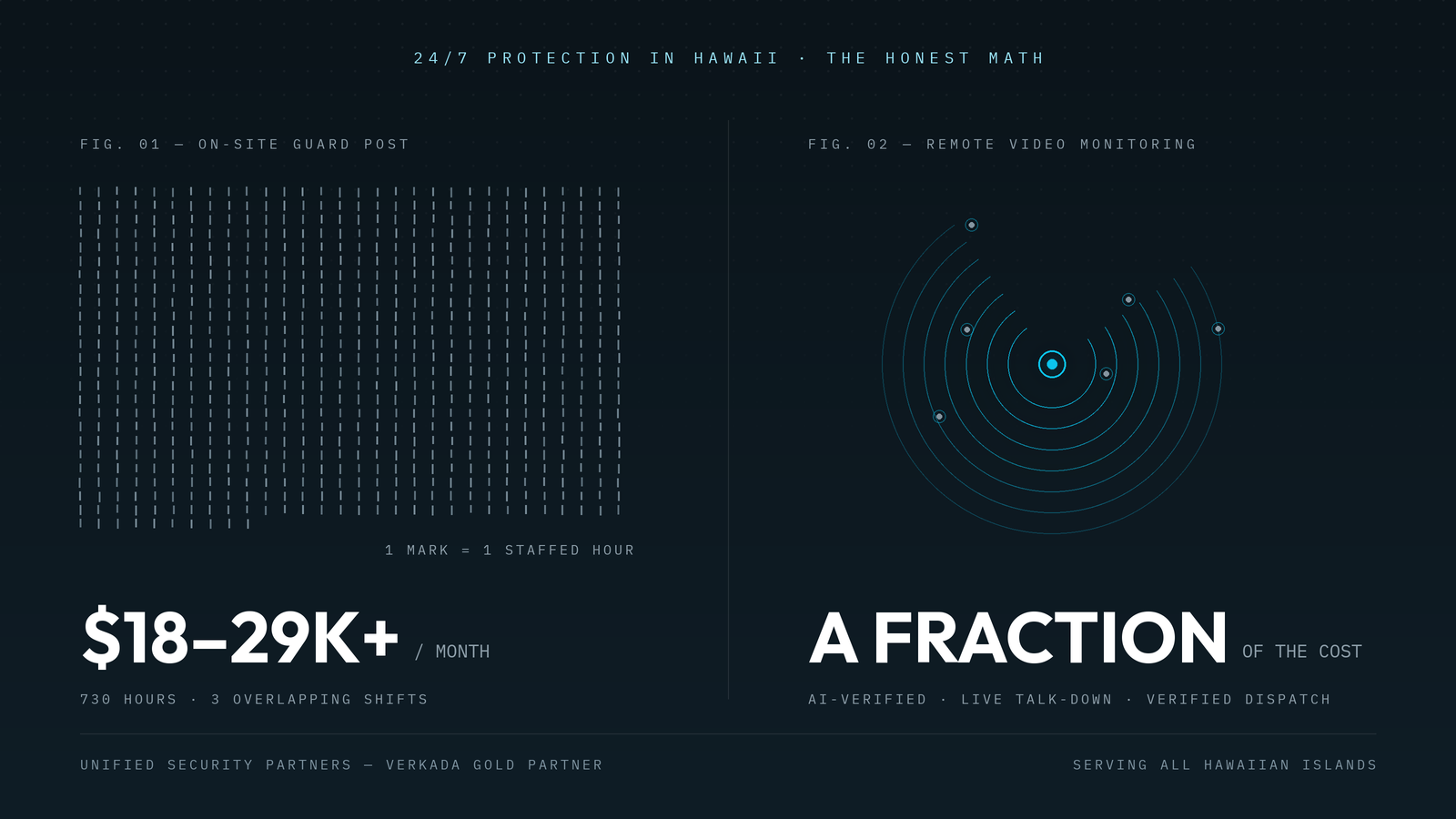 One month of 24/7 coverage: 730 staffed hours versus one monitored system with AI-verified detection.
What does remote video monitoring cost in Hawaii?
Most Hawaii businesses can put professional live video monitoring on a property for a few hundred to a low few thousand dollars per month — typically 5–10% of the cost of a 24/7 guard post, often less. Instead of paying for 730 human hours, you're paying trained agents to watch only when something is actually happening.
Three components make up the real cost. Camera hardware is a one-time purchase, cloud licensing is annual, and the monitoring service is monthly — we've published honest local ranges for the first two in our guide to what commercial security cameras cost in Hawaii. The monitoring layer itself scales with camera count and hours of coverage: an overnight package watching a handful of exterior cameras costs far less than 24/7 coverage of a large site. And if intrusion detection is the core need, a cloud-based alarm system includes professional monitoring with the license — no separate monthly monitoring contract stacked on top.
The other difference is what happens to the money. A guard contract is pure operating expense, forever. A camera system is mostly a capital purchase that keeps recording, deterring, and providing evidence around the clock — the monitoring service rides on top of an asset you own.
How does remote monitoring deter crime without a person on site?
Modern remote monitoring doesn't just record a crime for later — AI-verified events from your commercial security cameras in Hawaii escalate to live agents in real time, and those agents can intervene on the property through on-site hardware. When a camera detects a person in a monitored zone after hours, the event is verified — first by AI analytics that filter out headlights, cats, and swaying palms, then by a trained agent looking at live video.
From there, deterrence is active: the agent can trigger talk-down audio through on-site speakers ("You in the gray hoodie — you are being recorded and police are being contacted"), fire strobes and sirens, and escalate to police with live video evidence in hand. Most prowlers leave the moment the speaker addresses them by description — that specificity tells them a human is watching right now. It's the same outcome you're buying with a guard — someone notices, intervenes, and calls for help — delivered in seconds, without a person standing in the parking lot all night.
When does an on-site guard still make sense?
Keep a human post wherever presence itself is the job. Front-desk and lobby posts that greet visitors, posts that physically escort staff or patrol interiors, venues managing crowds, and sites with active in-person de-escalation needs are guard work, and cameras don't replace them.
That's why the strongest model for many Hawaii properties is hybrid: staff the guard where people interact with them, and let remote monitoring take the hours that drain the budget — nights, weekends, and holidays, when a guard's main duty is watching empty space at premium pay. Cutting a 24/7 post down to business-hours coverage can remove two-thirds of the guard bill while the property stays watched every minute. Job sites are the clearest case — see our guide to construction site security in Hawaii for how solar LTE cameras and monitoring replace the overnight guard shack.
What about false alarms and police response in Honolulu?
Video verification changes the false-alarm math, and in Honolulu that has a real dollar value. Traditional blind alarms generate false trips that cost you fees and goodwill — Honolulu requires an alarm permit, and repeat false alarms carry escalating fines, which we break down in our Honolulu alarm permit and false-alarm fee guide. A monitored event backed by live video means the call that goes to police is a verified crime in progress with a description of the suspect — a very different call, and one that gets a very different response.
How USP helps Hawaii businesses compare the options
Unified Security Partners is a locally owned Verkada Gold Partner in Honolulu, serving businesses across all the Hawaiian Islands since 2019. We start with a site assessment and an honest conversation about which hours genuinely need a human and which are better covered by cameras, then handle system design, cloud licensing, and monitoring configuration, with physical deployment performed by licensed contractor partners. Because the platform is cloud-managed, a property manager on Oahu can watch sites on Maui or the Big Island from one dashboard — no server rooms, no site visits to pull footage.
Frequently Asked Questions
How much does a security guard cost per hour in Hawaii? Contracted unarmed guards in Hawaii commonly bill at $25–40+ per hour, with armed posts higher. The guards themselves typically earn $17–22 per hour in Honolulu — the difference covers the agency's payroll costs, insurance, training, supervision, and margin. These are market ranges, not quotes.
What is the cheapest way to get 24/7 security coverage in Hawaii? For most properties, cloud cameras with remote video monitoring is the lowest-cost path to true around-the-clock coverage — typically a few hundred to a low few thousand dollars per month, versus $18,000+ for a single 24/7 guard post. Sites that need intrusion detection first can start with a monitored cloud alarm system, which includes professional monitoring with the license.
Can remote video monitoring fully replace security guards? For after-hours protection of most commercial properties, yes — verified detection, live talk-down, and police escalation cover what an overnight guard provides. Roles built on human interaction, like lobby posts, escorts, and crowd management, still call for people, which is why many Hawaii businesses run a hybrid: guards during business hours, remote monitoring overnight.
Does remote video monitoring work on the neighbor islands? Yes. Because the system is cloud-based, monitoring agents watch a warehouse in Kahului or a dealership in Hilo exactly as they would a Honolulu site, and you manage every island's cameras from one dashboard. There's no on-site recorder to service, which matters when the property is a flight away.
Will remote monitoring agents actually call the police? Yes — when an agent verifies a crime in progress on live video, they escalate to the police with a real-time description of what's happening. Video-verified calls give responding officers far better information than a blind alarm signal, and verification first means false trips get filtered out instead of becoming fees under Honolulu's alarm ordinance.
How long does it take to set up remote video monitoring in Hawaii? Typically a few weeks from site assessment to live monitoring, depending on camera count and site conditions. USP handles the assessment, system design, licensing, and monitoring configuration, and physical deployment is performed by licensed contractor partners — most single-site projects move quickly because there's no server infrastructure to build.