
Quick answer: Security cameras in Hawaii fail from the outside in. The image sensor almost never dies first; what fails is the mounting hardware, the cable connection and the housing seal after a few years of salt spray, 70 percent humidity and afternoon sun. The cameras that last are sealed to IP66 or IP67, impact-rated IK10, mounted with 316 stainless hardware and sealed connectors, placed out of direct spray where the site allows, and monitored from the cloud so a failing camera is flagged the day it starts to fail, not the day you need the footage.
Every integrator in Hawaii has seen the same photo: a bullet camera on a beachfront hotel, rust streaks down the wall, bracket frozen, lens fogged from the inside. It was probably a decent camera, put in the wrong place with the wrong hardware, and nobody knew it had stopped recording until something happened. Here is what actually corrodes, what the ratings on a spec sheet mean for a Hawaii site, and how we design commercial security cameras in Hawaii to last, from a Honolulu team that has specified Verkada systems on every island since 2019.
Why does Hawaii kill security cameras faster than the mainland?
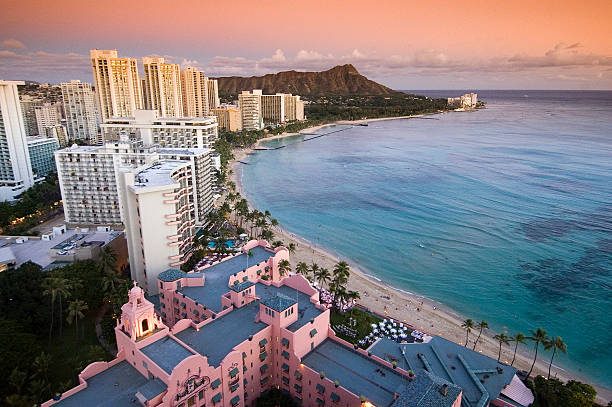
Salt, humidity and sun, all year, with no winter to give hardware a break. Corrosion engineers rate outdoor environments on the ISO 9223 scale from C1 to C5, and coastal Hawaii sites commonly land in C4 or C5, the high and very-high categories, with exposure driven by distance from the surf and which way the trade winds blow. Salt spray is heaviest in roughly the first few hundred feet from breaking waves and drops off quickly inland, which is why a camera on a Waikiki pool deck, a Kewalo Basin harbor yard or a Kailua beachfront condo lives a much harder life than the same model at a Kapolei warehouse two miles from the water.
Humidity does the slow work. Honolulu runs around 65 to 75 percent relative humidity most of the year, windward and Hilo-side sites are wetter still, and moisture finds any gap in a housing seal or any bare RJ45 connector in a junction box. Add UV that chalks plastic and a west-facing wall in Kona that cooks a camera every afternoon, and a camera that would last ten years on the mainland can be a warranty claim in three.
What ratings should a Hawaii security camera have?
IP66 or IP67 for water and dust, IK10 for impact, and a warranty long enough to matter. IP66 means the housing withstands powerful water jets; IP67 means it survives temporary immersion, so it is the safer pick where spray is constant. IK10 is the top impact rating and matters as much for a rock from a mower or a ladder bumping a garage camera as for vandalism. Verkada's outdoor domes, bullets, fisheyes and multisensor cameras carry IP66 or IP67 and IK10 ratings, and Verkada backs its cameras with a 10-year warranty, a real hedge in a corrosive climate.
One caveat: IP and IK ratings say nothing about corrosion. No camera manufacturer we work with publishes a salt-fog rating, and a sealed housing does not protect the bracket, the screws or the conduit it hangs from. That is where the rest of this guide comes in.
How should cameras be mounted in salt air?
With stainless hardware, no dissimilar metals touching, and every connection sealed. The details that separate a five-year camera from a fifteen-month one:
- 316 stainless fasteners and brackets. Zinc-plated and 304 stainless screws rust in months near the shore. 316 marine-grade is the minimum within sight of the ocean, including the wall anchors.
- Isolate dissimilar metals. An aluminum camera body bolted to a galvanized bracket forms a galvanic couple that eats the softer metal. Nylon washers or a dielectric barrier stop it.
- Seal the cable path. Outdoor-rated cable, a gasketed junction box behind the camera, and a weatherproof boot or gel-filled connector on the RJ45. A bare cable through a hole with a dab of caulk is the most common failure we find on site walks.
- Drip loops and conduit. Cable should drop below the camera and rise into it so water runs off, and exposed runs belong in PVC or stainless conduit, never zip-tied to a railing.
- Rinse and inspect. A freshwater rinse a few times a year and a yearly look at brackets and seals catches rust before it seizes a mount.
USP designs the placement and specifies the mounts, brackets and cable path in the proposal; physical mounting and cabling are performed by licensed Hawaii contractor partners. Getting the spec on paper keeps a crew from defaulting to whatever hardware is on the truck.
Where should cameras go to avoid the worst exposure?
Under an eave, on the lee side, and back from the spray line whenever the view allows. A dome tucked under a lanai overhang sees the same walkway as a bullet on a pole at the seawall and gets a fraction of the salt. Where a camera has to face the water, a rain hood and a slight downward tilt keep spray off the lens, and a fisheye covering a deck from a protected wall can replace two exposed bullets. For a fence line or parking lot with nothing to hide behind, Verkada's IP67 bullet cameras are the right tool, paired with the mounting spec above.
Indoors, the enemy is the equipment closet. Many Hawaii businesses are replacing NVR-based systems because the recorder sat in a hot back room and died first, taking every camera's footage with it. Verkada cameras store video onboard and back it up to the cloud, so there is no recorder to bake and nothing to lose in a storm beyond the camera itself, which is why they anchor our hurricane season checklist.
How do you know a camera is failing before you need it?
Because the platform tells you. The classic Hawaii failure is a camera that quietly went offline six weeks before the incident. Verkada Command monitors every camera's health, alerts you when one drops offline or its image degrades, and shows the last footage it captured, so a corroded connector becomes a service ticket instead of a gap in the record. USP watches those alerts for the systems we support and coordinates the fix, which for a Honolulu security system usually means a same-week visit rather than a mainland support queue. If you are pricing a new system, our camera cost guide for Hawaii covers what drives the number; if you already have cameras and want to know whether they will survive another summer, a site walk is free.
Frequently Asked Questions
Do Verkada cameras hold up in Hawaii salt air? Yes, when mounted correctly. Outdoor Verkada models are sealed to IP66 or IP67 and impact-rated IK10, with a 10-year warranty. The housing is rarely the weak point; the bracket, fasteners and cable connections are, so we specify 316 stainless hardware and sealed connectors on every coastal site.
What does IP66 vs. IP67 mean for a camera in Hawaii? Both are sealed against rain and wash-down. IP66 resists powerful water jets and IP67 survives temporary immersion, so IP67 is the safer choice where spray is constant, such as a pool deck, harbor or beachfront railing. Neither rating covers corrosion of the mount.
How far from the ocean does salt air affect cameras? Salt spray is heaviest within the first few hundred feet of breaking waves and drops off quickly inland, but trade winds carry it further on windward coasts. We treat anything within sight of the water, and any windward site, as a high-corrosion deployment.
Can I keep my existing cameras and just fix the corrosion? Often, yes. If the camera still produces a clean image, replacing rusted brackets and fasteners with 316 stainless and resealing the connection usually buys years. If the lens is fogged from the inside, the seal has failed and the camera should be replaced.
Does humidity affect indoor cameras too? Yes, in unconditioned spaces such as parking garages, stairwells, loading docks and back-of-house corridors. Sealed outdoor-rated models are the right choice there even though the space is technically indoors.